They keep trying to make neural interfaces happen, and I'm sceptical about 90% of the venture; as far as big tech is concerned, there's a 'closed' sign on my grey matter, thanks. Still, the other 10% of brain-computer interface projects present genuine medical advancements worth getting excited about.
A team of researchers at Feinstein Institutes for Medical Research in Manhasset, New York, have created a brain-computer interface that both allows patients to not only move paralysed limbs, but to feel them once more too (via ). The team is led by Chad Bouton, vice president of advanced engineering at the institute, and they achieved the aforementioned with a "double neural bypass" system they've been working on since at least 2015. Unsurprisingly, it turns out .
Anyway, let's keep this positive. That original 2015 experiment created a single "neural bypass"—essentially an array of electrodes implanted directly into a patient's motor cortex. This brain chip would listen in on neural activity, and an AI model would match the incoming brain waves to the patient's intended body movements. The team's latest "double neural bypass" experiment opens another channel of communication, allowing sense data to be fed back to the patient's brain as they move. However, rather than implanting just two brain chips as the term "double neural bypass" may suggest, the patient at the centre of the Feinstein team's research was kitted out with five, incorporating a total of 224 electrodes into his grey matter.
To return motion and feeling to his paralysed limbs, the team implanted two electrode arrays into Thomas' motor cortex, alongside three similar chips into his somatosensory cortex (the bit of the brain responsible for touch). An AI model interpreted Thomas' brain signals and then stimulated further electrode arrays implanted in his neck and arm. These served to modulate the patient's spinal cord and forearm muscles respectively, allowing for movement.
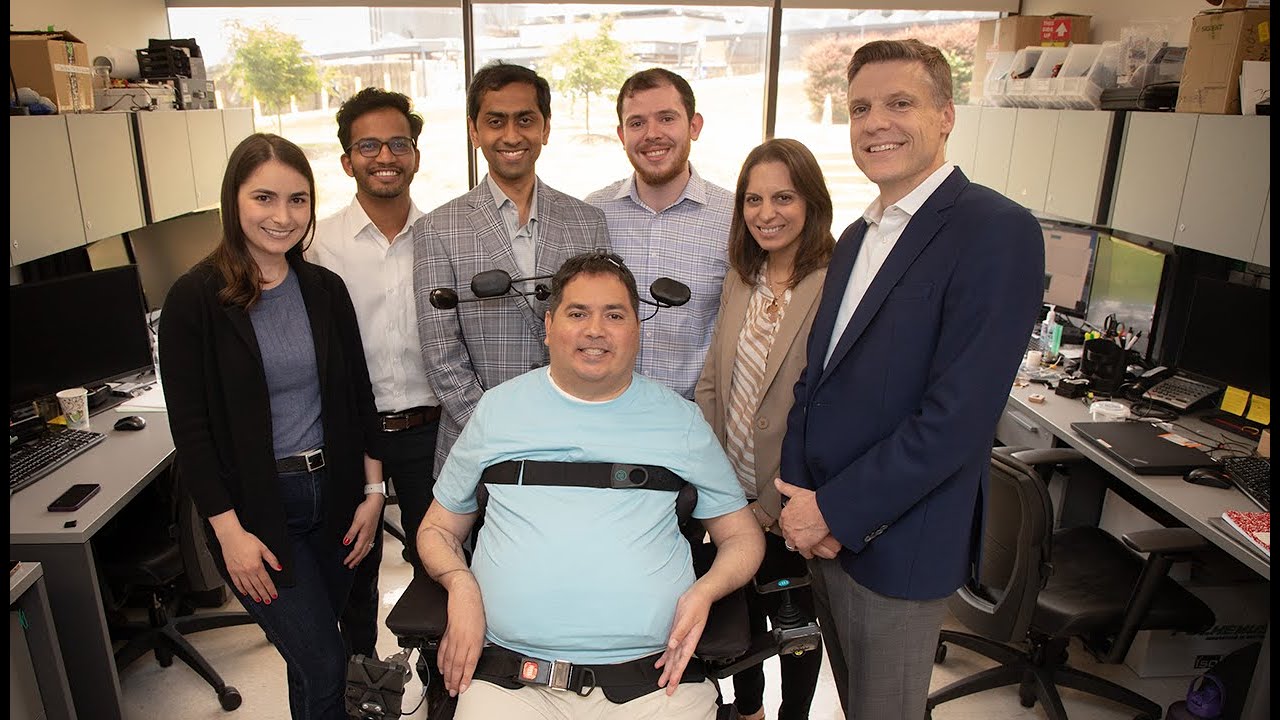
Over the course of the experiment, Thomas has been able to rebuild the strength in his arm. He's now able to reach up and touch his face or drink from a cup unassisted. The addition of somatosensory cortex stimulation also means Thomas can feel what he touches, allowing him to better modulate his grip strength and, as the team claims, pick up an empty egg shell without cracking it.
Even more exciting though is that Thomas can now sense some sensation in his U31 com arm even when he's not hooked up to the "double neural bypass" system. The researchers are not yet entirely sure why this is, but it's possible that neuroplasticity has allowed Thomas' brain to 'relearn' how to interpret sensory information.
Research team leader Chad Bouton explained, "It is known from animal experiments electrical stimulation can promote neuronal growth, but here it is unclear whether it’s more about strengthening spared connections at the spinal cord injury site. Right now, we just know the results are significant and leading to functional and meaningful outcomes.”
Researchers across the field have been successfully returning motion to paralysed limbs via brain-computer interfaces . In fact, one early neural bypass experiment even returned such an impressive range of motion to one young man that . However, these experiments have largely been a one-way street, returning motion but not sensation—until now.
This also isn't the first time AI has been deployed as a genuinely assistive technology; by my count, the last genuinely helpful thing Meta did as a company was conduct research that could one day . A few more scientific leaps and I might actually warm up to the idea of a brain chip.